U.S.-Taiwan Military Aid Imbalance Threatens Strategic Stability, Experts Warn
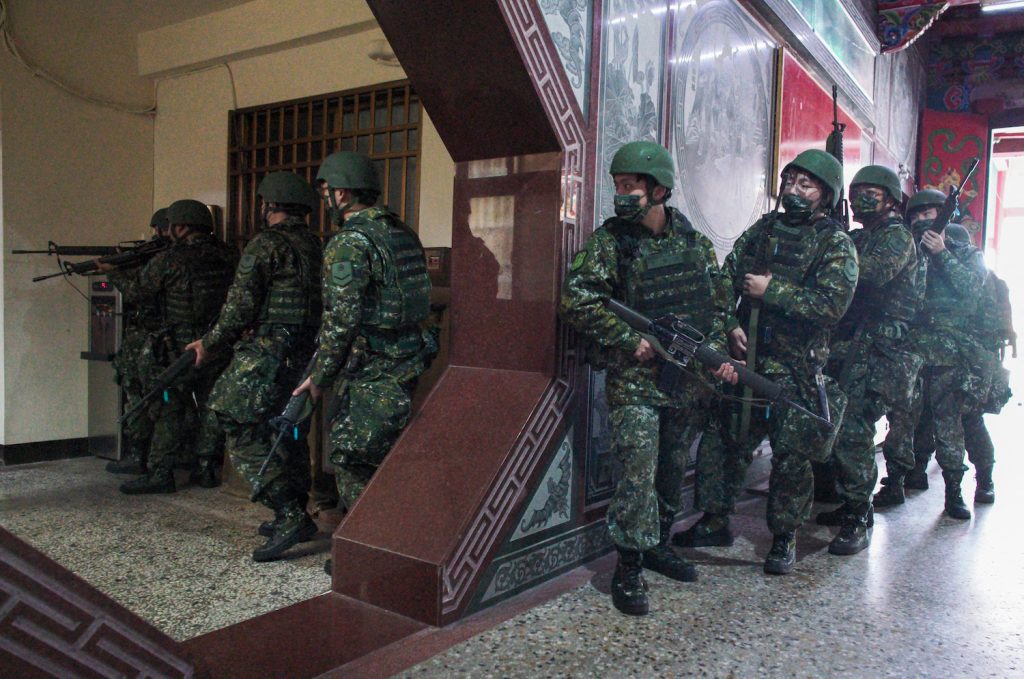
Taiwan’s reserve soldiers take part in military training during a two-week education convocation at a local Taoist temple in Hsinchu on March 19, 2024. (Photo by Sam Yeh / AFP)
By Brian Freeman | Wednesday, 24 December 2025 11:39 AM EST
The state of U.S. military aid to Taiwan is out of balance, according to U.S.-Taiwan Business Council President Rupert Hammond-Chambers.
At a Hudson Institute think tank event earlier this month, Hammond-Chambers argued that although the U.S. has sent Taiwan an increasing number of asymmetric weapons intended to help deter and defeat a potential Chinese invasion, Taiwan needs a more balanced arsenal of systems to counter other scenarios such as a sustained blockade.
He said that U.S. weapons sales have “swung from one extreme” — the arms deals years ago for MQ-9 Reaper drones, M1A2 Abrams tanks, and F-16 Fighting Falcon jets — “to the other extreme where we’re only doing asymmetric,” a shift he warned leaves potential vulnerabilities.
U.S. officials have argued that survivable, distributed, and networked systems are better suited to helping Taiwan counter China’s daily gray-zone pressure, as well as complicating Beijing’s designs in a crisis or blockade.
Taiwan has been concentrating on building its asymmetric capabilities to deter and defend against a full-scale invasion.
Hammond-Chambers said military support and sales have been aligned with countering that, “but we are not doing every day, and there needs to be a swing back and more of a balance.”
Taiwan’s defense ministry stated that the U.S. “continues to assist Taiwan in maintaining sufficient self-defense capabilities and in rapidly building strong deterrent power and leveraging asymmetric warfare advantages, which form the foundation for maintaining regional peace and stability.”
One of the most complicated challenges facing Taiwan is how it can develop and stockpile its own weapons systems should a blockade prevent assistance from the U.S. and other allies.
Retired Adm. and former chief of the general staff for Taiwan’s Defense Ministry Lee Hsi-Min said at the event that one answer is to produce weapons at scale on the island, rather than relying mainly on co-production or foreign supply.
Experts and officials have long stressed the need for a stronger local defense supply chain so that Taiwan can remain operational if outside support is delayed or disrupted.
But while Taiwan’s domestic defense industry can continue to develop its own weapons, “the fastest way to production is to license American and Ukrainian and European designs and to produce on island,” Betsy Shieh, former senior commercial officer with the U.S. Department of Commerce, said at the event.