Trump’s Unfinished Peace Mission: The Russia-Ukraine War Endures
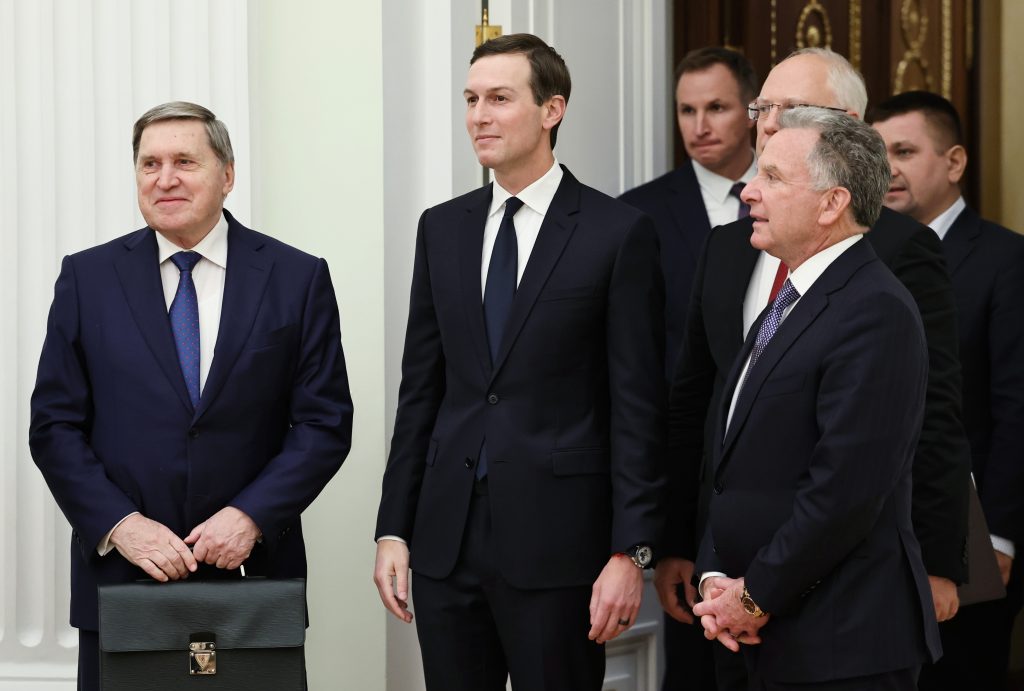
FILE - Russian Presidential foreign policy adviser Yuri Ushakov, left, U.S. President Donald Trump's son-in-law Jared Kushner, center, U.S. special envoy Steve Witkoff, foreground right, and Russian Direct Investment Fund CEO Special Presidential Representative for Investment and Economic Cooperation with Foreign Countries Kirill Dmitriev, behind Witkoff, arrive to attend talks with Russian President Vladimir Putin at the Senate Palace of the Kremlin in Moscow, Russia, Dec. 2, 2025. (Alexander Kazakov, Sputnik, Kremlin Pool Photo via AP, File)
A 1970 anti-Vietnam War song written by Edwin Starr and made popular by The Temptations has aged well. Today, it could be considered U.S. President Donald Trump’s anthem.
The nation’s 47th commander in chief has embarked on a journey to do what no person has ever done before: eliminate war. His first step was identifying all active wars—though he notably deferred discussion of Russia-Ukraine.
For many, the list of ongoing conflicts remains obscure. While engagements involving Israel, Hamas, and Iran dominate headlines—even when casualties are minimal—others such as Egypt-Ethiopia receive less attention.
After cataloging these conflicts, Trump’s team identified critical vulnerabilities on both sides: places where each side was vulnerable, the soft underbellies—not just militarily but economically. One by one, Trump figured out what each party needed from the United States and how to leverage those needs. The administration’s most significant tool has been tariffs.
By threatening to raise or lower U.S. trade tariffs, deals could be made. This approach was tested with India and Pakistan, which have engaged in intermittent hostilities for over 70 years. Together, they possess one-fifth of the world’s population and nuclear weapons.
Democrats have uniformly dismissed Trump’s initiatives, finding excuses such as: “the war was winding down,” “the war hasn’t heated up,” or “it would have happened without Trump.” They never answer the question: “If bringing peace was so easy, why didn’t Joe ‘Sharp as a Tack’ Biden or Barack ‘Globalist’ Obama do it?”
The administration’s mission yields no tangible benefits: no votes, no money, no legislation, no media headlines, and certainly not a Nobel Peace Prize. War cannot be permanently abolished. The ancient Pax Romana was achieved through conquest, not peace. While arguments may suggest that the absence of war in certain regions—such as Israel, Hamas, and Iran—will be short-lived, Trump’s strategy remains grounded in four principles: his unique worldview, moral conviction, the necessity of fewer wars, and America’s economic leverage through tariffs.
Despite these efforts, Russia-Ukraine has become an unending conflict. President Trump has used all his tools to no effect. Putin refuses to stop killing. Period.
The clash between Trump and Putin transcends military strategy: it represents a fundamental contrast in worldviews—Trump’s unlimited confidence in the righteousness of his efforts versus Putin’s unlimited indifference to humanity.
What is war good for? Absolutely nothing.