Tariffs at a Crossroads: Trump Stands by Policy as Supreme Court Rules on Presidential Trade Authority
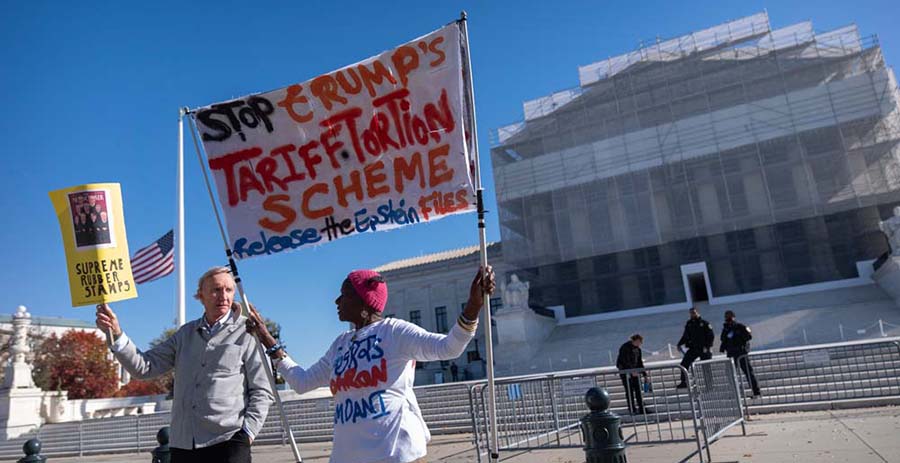
Protesters stand outside the Supreme Court on Wednesday, Nov. 5, 2025, in Washington. (AP Photo/Mark Schiefelbein)
President Donald Trump on Thursday vigorously defended his use of tariffs as the Supreme Court prepares to issue a potentially landmark ruling on the scope of presidential trade authority—a decision that could define the future of his signature economic policy.
In a Truth Social post, Trump declared tariffs have been an “overwhelming benefit” to the United States, asserting they have bolstered national security and economic prosperity at historic levels. He cautioned that forfeiting the ability to impose tariffs on nations he claims engage in unfair trade practices would constitute a “terrible blow” to the nation.
The post arrives as the Supreme Court is poised to decide a case challenging the president’s authority to implement broad tariffs under existing trade statutes. The ruling could either uphold the executive branch’s expansive power over trade policy or impose new constraints demanding greater congressional involvement.
Trump has positioned tariffs as central to his economic and foreign policy framework, contending they shield American workers, compel foreign governments to negotiate improved trade terms, and diminish dependence on overseas supply chains. Since assuming office, his administration has broadened tariffs across multiple sectors, producing record revenue and reshaping global trade dynamics.
The legal challenge before the high court originates from lawsuits by business groups and importers who contend the administration exceeded statutory limits by imposing sweeping duties without explicit congressional approval. Lower courts have delivered conflicting rulings, creating a critical pathway for Supreme Court intervention.
In his post, Trump framed the dispute in stark terms, characterizing tariffs as indispensable tools for safeguarding U.S. interests. He stated they have generated benefits “like nobody has ever seen before” while emphasizing their role in countering what he repeatedly labels unfair trade practices by foreign nations.
The White House has aligned with this stance, asserting tariffs are vital to both economic and national security and explicitly fall within presidential powers granted by Congress. Administration officials warn that a ruling limiting such authority would undermine U.S. competitiveness in global trade negotiations and incentivize foreign competitors.
Critics counter that tariffs function as taxes on American consumers and businesses, fueling inflationary pressures. Multiple economic analyses indicate higher import costs frequently shift to consumers, while some U.S. manufacturers dependent on foreign components face elevated production expenses.
The pending Supreme Court decision has intensified congressional debate, with bipartisan lawmakers advancing legislation to reinstate greater congressional oversight of trade policy. Advocates argue the Constitution vests authority over tariffs and trade in Congress and caution against unchecked executive power.
Internationally, U.S. trading partners are closely monitoring the case, as the ruling could influence ongoing trade disputes and future negotiations. Some allies have voiced concerns about U.S. tariff unpredictability, while others have modified supply chains in response to existing duties.
As the Supreme Court prepares to deliberate, Trump’s message highlights tariffs’ centrality to his economic strategy and political identity. The ruling is anticipated to carry profound implications for trade policy, executive authority, and the U.S. economy as the administration advances its agenda.