Senate Immigrant Funding Battle Threatens Immediate Partial Government Shutdown
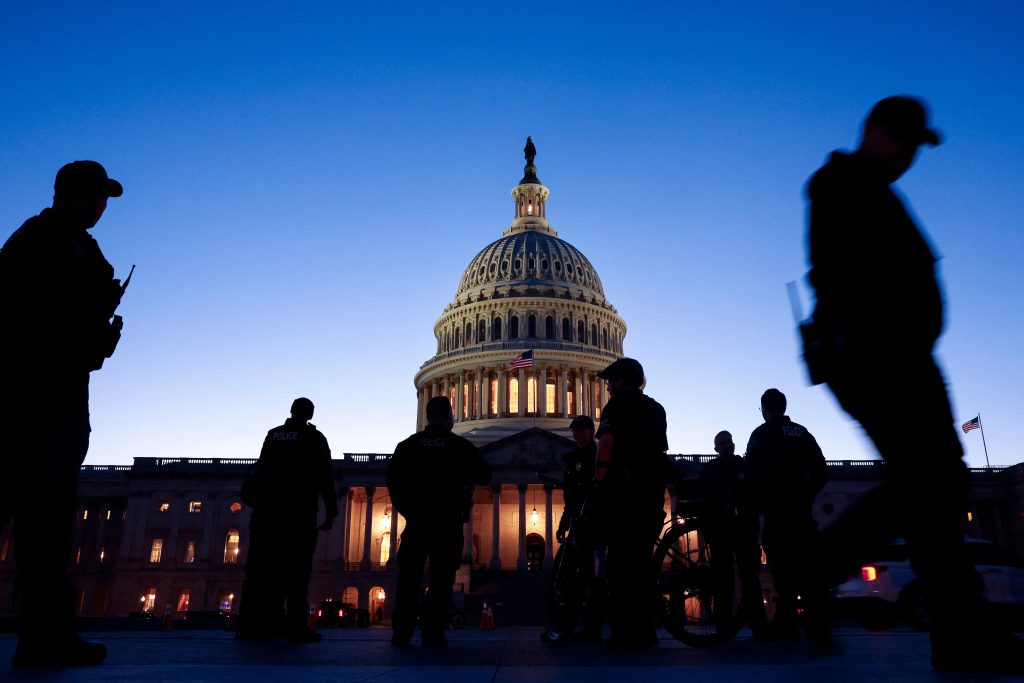
U.S. Capitol Police officers stand guard outside the Capitol prior to the State of the Union address by U.S. President Joe Biden to a joint session of Congress, in Washington, U.S., March 7, 2024. REUTERS/Evelyn Hockstein
With a Friday deadline for federal funding rapidly approaching, key Senate lawmakers are facing what one top Washington insider describes as a “nightmare” scenario following a federal agent’s shooting of a man in Minnesota on Saturday. The six-bill spending package, which includes Department of Homeland Security (DHS) and Immigration and Customs Enforcement (ICE) funding, is unraveling.
Jake Sherman, co-founder of Punchbowl News and a well-connected Beltway observer, warned lawmakers and stakeholders Saturday that he “cannot see a scenario in which Senate Democrats can vote for this 6-bill package, which includes DHS funding,” underscoring deep resistance within the Democratic conference. “This ICE situation is a nightmare for the Senate,” he stated on X. “Government shuts down Friday. First Senate procedural vote likely not until Wednesday, giving them limited room to maneuver. House on recess. Any changes to the bill would require the House. Shutdown a real possibility at this point.”
The compressed timeline is further complicated by the U.S. House of Representatives’ current recess, which eliminates rapid negotiations or quick legislative fixes in the lower chamber if objections arise on the Senate floor. Any substantive changes to the package—including the DHS title that funds ICE—would need reconciliation by the House, a chamber with its own internal divides and competing priorities. The absence of legislative activity and a clear path forward have heightened the risk of a partial government shutdown as early as next weekend.
Senate Democrats have objected to several provisions in the current spending package, particularly related to immigration enforcement funding levels and policy riders. GOP leaders negotiated the package with the goal of securing bipartisan support to advance the bills, but Democrats’ resistance has undermined that strategy. Republicans have signaled they are wary of funding ICE without concessions on border security and enforcement policy, making a deal that satisfies both sides increasingly unlikely. While leadership in both parties recently expressed confidence in reaching a funding agreement, Sherman’s comments reflect growing skepticism among insiders that compromise is imminent.