Senate GOP Moves to Force ‘Talking Filibuster’ on Voter ID Bill Amid Democratic Opposition
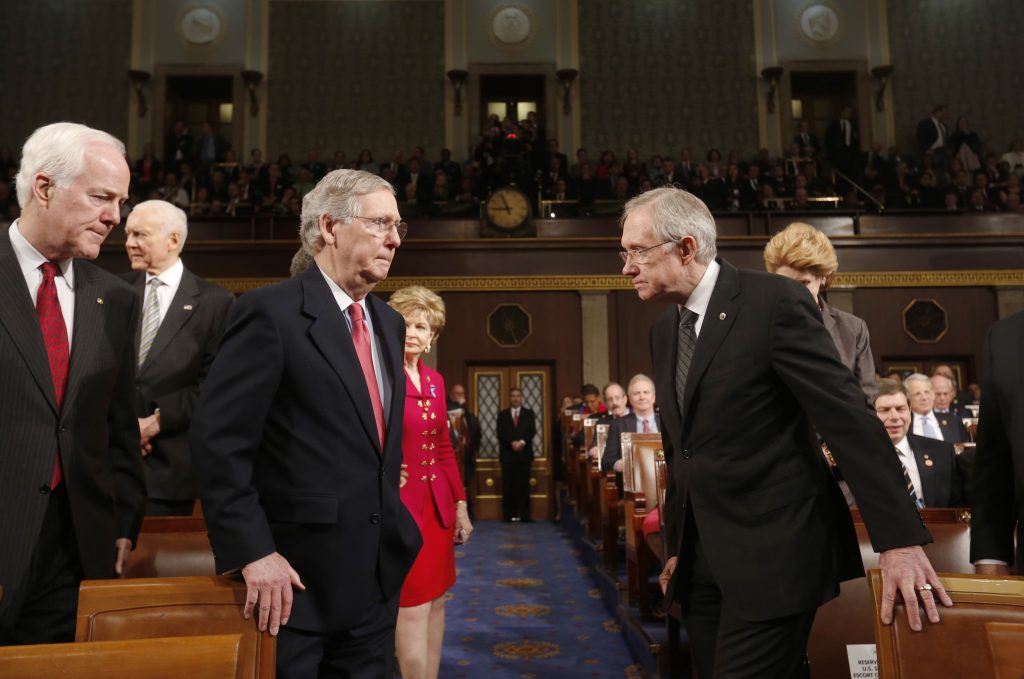
U.S. Senate Minority Whip John Cornyn (L), Senate Minority Leader Mitch McConnell (2nd L) and Senate Majority Leader Harry Reid (R) head to the front of the chamber together before President Barack Obama delivers his State of the Union speech on Capitol Hill in Washington, January 28, 2014. REUTERS/Larry Downing (UNITED STATES - Tags: POLITICS) - TB3EA1T07R4IC
By Theodore Bunker | Monday, 16 February 2026 03:35 PM EST
Senate Republicans say they have enough support within their conference to advance legislation that would require proof of U.S. citizenship to register to vote and a photo ID to cast a ballot, but the bill faces unified Democrat opposition and the Senate’s 60-vote threshold.
The bill, known as the Safeguard American Voter Eligibility Act — or SAVE America Act — cleared the House on Wednesday by a 218-213 vote and now heads to the Senate where Republicans hold 53 seats, short of the votes typically needed to end debate without Democrat support.
Republicans argue the bill is necessary to deter fraud, including double voting, voter impersonation, and noncitizen voting. Democrats contend that the new documentation requirements would make it harder for some eligible voters to participate and could disproportionately affect minority voters.
With rule changes off the table, GOP leaders and conservative activists are pushing for a procedural gambit known as a talking filibuster. This tactic requires lawmakers attempting to block a bill to physically hold the floor and speak continuously to prevent a vote, rather than simply signaling opposition to trigger the modern 60-vote cloture threshold.
Years ago, lawmakers seeking to delay legislation had to physically hold the floor — sometimes reading from cookbooks or newspapers — but in more recent times, filibusters have largely become procedural. Even the threat of one can slow passage.
“It works great in movies,” Sen. Roger Wicker, R-Miss., said, referencing the 1939 film “Mr. Smith Goes to Washington,” where a senator spoke for 23 hours to protest corruption.
In practice, the maneuver could still bog down the chamber because Senate rules and precedents allow extended debate and a flood of procedural motions and amendments, even if leaders try to box in the process.
“There aren’t anywhere close to the votes — not even close — to nuking the filibuster,” Senate Majority Leader John Thune, R-S.D., said when asked about passing the bill.
“And so that idea is something, although it continues to be put out there, is something that doesn’t have a future,” Thune added.
“Is there another way of getting there? We’ll see,” he said, noting Republicans are discussing alternatives.
Sen. Mike Lee, R-Utah, the bill’s lead sponsor, has urged colleagues to force Democrats to physically hold the floor. He argues that the modern filibuster lets senators block legislation with far less effort once cloture becomes the central test.
“Enforcing the Talking Filibuster is NOT ‘eliminating’ the filibuster,” Lee wrote in a post. “It’s just enforcing the Senate’s rules and making Democrats opposed to the SAVE America Act actually speak if they want to filibuster.”
“If we don’t do this now, we might as well prepare to lose,” Lee concluded.
Several conservatives, including Republican Sens. Ted Cruz of Texas, Ron Johnson of Wisconsin, and Rick Scott of Florida, have expressed support for the move.
Others warn that the tactic could burn scarce floor time Thune has said he wants for priorities such as housing, permitting, market structure, AI, the Farm Bill, and the highway bill.
“I’m very open to that,” said Sen. Josh Hawley, R-Mo.
“I’m not sure my colleagues are very enthusiastic about that,” he added.
On the Democratic side, Sen. Brian Schatz of Hawaii argued that forcing an around-the-clock floor fight would still amount to weakening the filibuster in practice.
“We tried the exact same thing, but nobody mistook that for maintaining the filibuster,” Schatz said.