Louisiana’s 75-Year-Old Environmental Lawsuit Scam: How State Officials Are Profiting From Ancient Claims
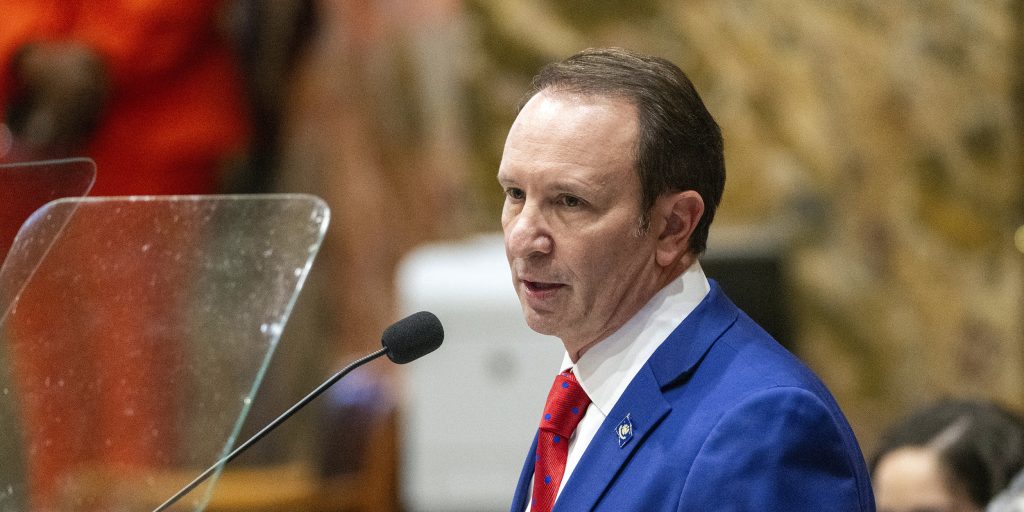
Gov. Jeff Landry speaks during the start of the special session in the House Chamber on Monday, Jan. 15, 2024, in Baton Rouge, La. Landry called for the special session only a few hours after taking office. (Michael Johnson/The Advocate via AP, Pool)
By Ernest Istook | February 13, 2026
The activist judiciary has long merited criticism. Yet so do elected officials who pass laws encouraging that activism.
Louisiana stands as a prime culprit in this trend. The state may be committing economic suicide because one-fourth of its economy is based on oil and gas.
Despite this vulnerability, state leaders—including Republicans and Democrats—have launched an all-out legal blitz to make the industry pay for environmental damages reportedly occurring during the 1940s.
A recent study ranks Louisiana as having more public corruption than any other state. By bringing such actions into state courts, Louisiana officials (including elected judges) have reaped millions in campaign contributions from private attorneys hired by government to file the lawsuits—attorneys who then collect a percentage for themselves.
Technically, the cases revolve around companies’ arguments that they were producing fuel for the American military during World War II, entitling them to apply federal law requiring related lawsuits be shifted into federal courts.
But more relevant to many Americans is the notion that today’s courts are being asked to award damages for events from the 1940s.
In 1978, Louisiana Democrats enacted a special law to justify claims that their coastline was severely eroded by industry practices during that war.
Whether coastlines were damaged in the 1940s remains unproven. However, such laws raise questions about how far back America’s courts and politicians are willing to go to satisfy the social justice movements of the American left.
Public officials should not be allowed to evade responsibility for enabling and encouraging courts to provide government with billions of dollars—costs ultimately passed along to consumers through higher prices—all based on claims that are decades old.
This practice is not labeled as tax increases, but officials bear the same blame as if they had raised taxes by billions.
Unfortunately, the case before the U.S. Supreme Court will not be decided using this standard. The court is not being asked to determine limits for dredging up claims that are 75-plus years old.
The sole question involves moving these cases into federal courts away from state courts like Louisiana’s.
One concern is that Justice Samuel Alito recused himself from the case.
None of us can pre-judge the outcome if the case were sent to federal court; recent events have damaged public trust in the national judiciary.
Regardless of what happens, public indignation is overdue over state and local officials who play pass-the-buck games by enacting laws designed to create injustice.
When laws are bad, we should blame those who created them—not the courts.
Former U.S. Congressman Ernest Istook also heads the non-profit Americans for Less Regulation.