DHS Agents Threaten Civilians After Scanning Faces and License Plates During Immigration Observations
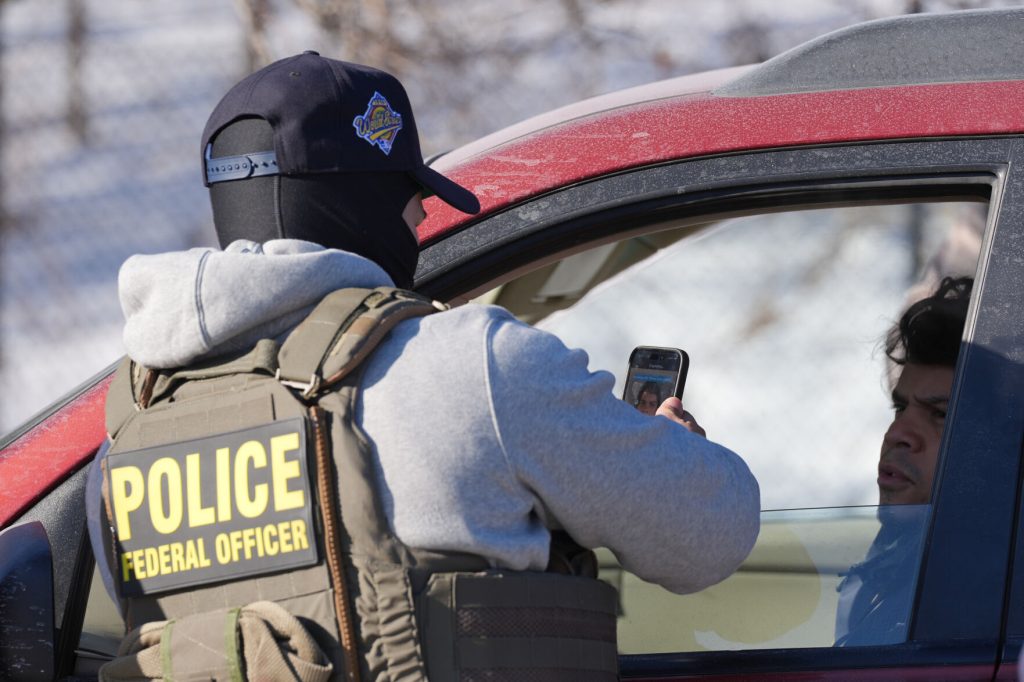
ADDS REFERECE TO FACIAL RECOGNITION APP - A federal agent uses a facial recognition app during a traffic stop on a person on Tuesday, Jan. 27, 2026, in Minneapolis. (AP Photo/Adam Gray)
A federal class action lawsuit has accused the Department of Homeland Security (DHS) of unconstitutionally retaliating against individuals who observe and record federal immigration enforcement operations by gathering their personal information and labeling them domestic terrorists.
The lawsuit, filed Monday in U.S. District Court in Maine, is on behalf of two Portland residents — Elinor Hilton and Colleen Fagan — against DHS Secretary Kristi Noem and the heads of Immigration and Customs Enforcement (ICE), Homeland Security Investigations (HSI), and Customs and Border Protection (CBP).
The complaint details multiple incidents where the plaintiffs alleged federal immigration officers scanned observers’ faces and license plates, then threatened to appear at their homes and place them on a domestic terrorist database.
The lawsuit seeks a court order blocking DHS from collecting and retaining personal information of people who observe or record immigration enforcement in public. It also requests that any records created be deleted.
According to the complaint, Fagan was recording an arrest in South Portland on January 23 when two masked agents approached her. One agent allegedly filmed her face, while another photographed her license plate. When Fagan asked why they were taking her information, an agent responded: “Cause we have a nice little database, and now you’re considered a domestic terrorist, so have fun with that.”
In a separate incident on January 21 outside a Home Depot in South Portland, Hilton said agents repeatedly filmed her at close range as she recorded an arrest from a distance. One agent allegedly warned her: “If you keep coming to things like this, you are going to be on a domestic terrorist watchlist. Then we’re going to come to your house later tonight.”
Hilton stated she left her home that night out of fear agents would follow through on the threat.
Both women claim they were standing in public areas and did not interfere with arrests.
The lawsuit, filed by the nonprofit Protect Democracy and two law firms, references DHS’ use of facial recognition tools, including a mobile application known as Mobile Fortify. The app allows officers to take photos and compare them against government databases containing millions of images. According to the complaint, photos taken with the app are retained in DHS systems for up to 15 years.
A DHS spokesperson stated that Mobile Fortify is designed to “quickly identify persons of interest” and that claims it violates the Fourth Amendment or compromises privacy are false. The spokesperson added that Mobile Fortify has not been blocked, restricted, or curtailed by courts or legal guidance and is lawfully used nationwide in accordance with all applicable legal authorities.
DHS Assistant Secretary Tricia McLaughlin denied the agency was compiling a database of “domestic terrorists” after Fagan’s video went viral. McLaughlin stated: “There is NO database of ‘domestic terrorists’ run by DHS.” She also added that while they monitor and investigate threats, obstructing law enforcement is a federal crime.
At a congressional hearing earlier this month, Rep. Lou Correa, D-Calif., asked Acting ICE Director Todd Lyons to respond to what the federal agent in Maine said about “a little database” in Fagan’s video. Lyons stated: “I can’t speak for that individual, sir. But I can assure you there is no database that’s tracking United States citizens.”
The lawsuit was filed amid reports that ICE launched Operation Catch of the Day across Maine on January 20, targeting approximately 1,400 illegal aliens in the state.