Claremont McKenna College President Hiram Chodosh Unveils AI Curriculum to Prepare Graduates for Tomorrow’s Challenges
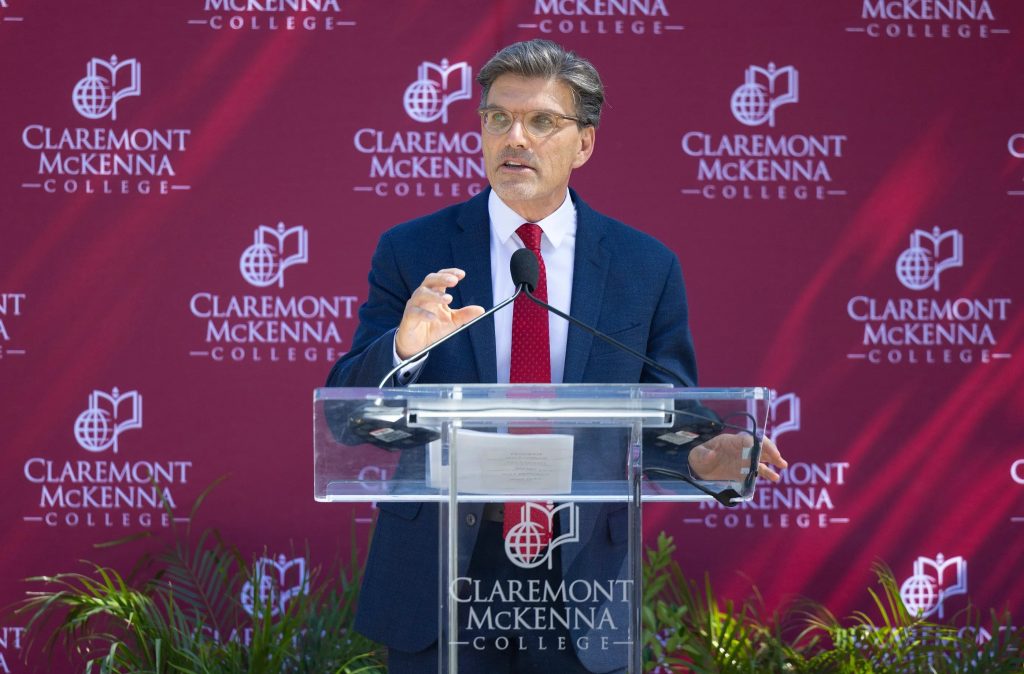
As he enters his final year as president of Claremont McKenna College, Hiram Chodosh is preparing for a new chapter focused on writing, teaching, and contributions to resolving national and global challenges in education, law, and civic leadership.
Chodosh’s work has consistently centered on helping individuals overcome barriers to their goals and aspirations, as well as addressing societal obstacles that impede collective progress.
The college, founded in 1946 as Claremont Men’s College by World War II veterans, has long emphasized a liberal arts curriculum designed to equip students with the ability to apply lessons from history, philosophy, literature, the arts, sciences, business, and government.
Mabel Benson, wife of founding president George Benson, wrote in the college’s first catalog that “there is no incompatibility between an education planned for specific types of leadership and an education designed to develop a liberally informed mind. In fact, real leadership presupposes the latter.”
As CMC’s fifth president, Chodosh implemented major initiatives aligned with this founding philosophy, including the Open Academy, the Kravis Department of Integrated Sciences, the Campaign for CMC: Responsible Leadership, the Care Center, the Soll Center for Student Opportunity, and a campus expansion that increased enrollment to 1,300 students.
Chodosh’s wife, Priya Junnar, who is also retiring this year, has served as director of the Marian Miner Cook Athenaeum for over a decade. This program brings scholars, public figures, thought leaders, artists, and innovators to campus four nights weekly throughout the academic year.
Nearly three out of every four CMC students participate in research with faculty through the college’s eleven research institutes and centers. In 2023, the Campaign for CMC raised nearly $1.1 billion, which bolstered existing programs and enabled a $400 million initiative to build scientific and quantitative fluency for all students via the Kravis Department of Integrated Sciences.
The new funding has led to the implementation of the “Codes of Life” course, requiring every student to learn how to develop artificial intelligence generative tools within the context of social science problems. The course covers coding, economics, ethics, and efficacy, preparing graduates to address complex challenges through team-based presentations.
Chodosh emphasized that this program serves as a template for a national initiative involving 125 college presidents, with plans to expand to 500-1,000 institutions by fostering collaborative problem-solving and constructive dialogue.
The president also stressed the importance of student-centered pedagogy, urging faculty to design courses that encourage diverse perspectives and foster independent thinking. Chodosh noted that classrooms should focus on interactions among students that continue beyond class time—where most real learning occurs.
In his vision for CMC graduates, Chodosh stated: “Our graduates can get around any new block because they have been there before. They know how to find a way to get around or through the obstacles to their success.”
With less than 10% of applicants accepted, Claremont McKenna maintains a selective student body. However, Chodosh acknowledged the growing societal challenge of individuals becoming disconnected from physical interaction and collaborative creation due to excessive screen time.
He called for greater collaboration between higher education and K-12 institutions to help students navigate the complexities of modern life while developing the skills necessary for meaningful engagement with the world.