Trump’s Board of Peace Faces Gaza’s Unresolved Dilemmas in Historic Opening Meeting
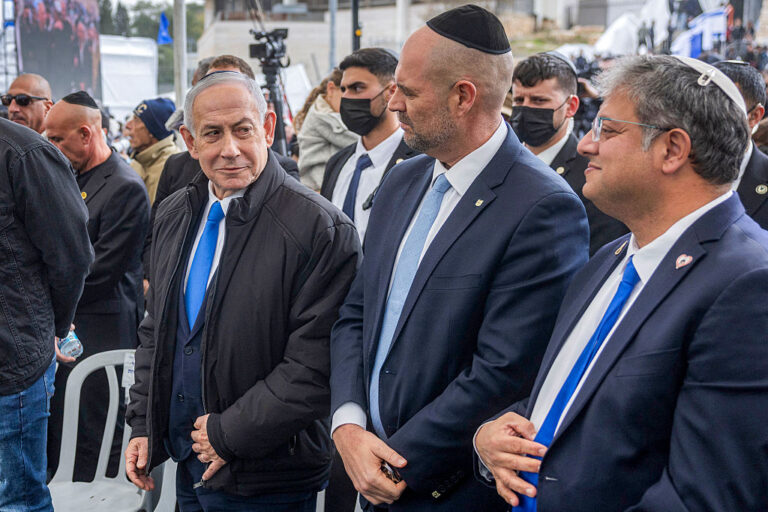
(L to R) Israel's Prime Minister Benjamin Netanyahu, Parliament (Knesset) Speaker Amir Ohana, and far-right National Security Minister Itamar Ben Gvir attend the funeral of Israeli hostage Ran Gvili, whose remains were finally brought back to Israel on January 26, in the southern town of Meitar on January 28, 2026. Hundreds of tearful mourners packed a stadium in southern Israel on January 28, 2026, for the funeral of Ran Gvili, the last Gaza hostage whose burial marks the end of a painful national saga triggered by Hamas's 2023 attack. Israeli forces on January 26 brought home the remains of Gvili, who was killed in action and whose body Palestinian militants took into Gaza during their October 7 attack, which triggered a devastating two-year war. (Photo by Chaim Goldberg / POOL / AFP via Getty Images)
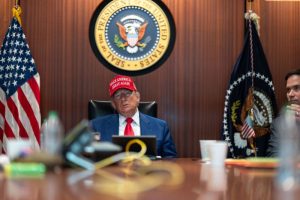
President Donald Trump will preside over the first meeting of his Board of Peace on Thursday, with critical questions about Gaza’s future looming over an event expected to include representatives from more than 45 nations.
Key challenges for the board include disarming Hamas terrorists, determining the size of a reconstruction fund, and ensuring timely humanitarian aid for Gaza’s war-torn population. These issues are likely to test the board’s effectiveness in the coming weeks and months.
Trump will address the group at the Donald J. Trump U.S. Institute of Peace—a building in Washington he recently renamed for himself—and announce that participating nations have raised $5 billion for a reconstruction fund. The money is expected to be a down payment on a fund that will likely require many more billions. A senior administration official confirmed that $1.2 billion each from the United Arab Emirates and Kuwait—two of Washington’s Gulf Arab allies—is included in the total.
Trump’s Board of Peace has drawn criticism for its controversial composition, which includes Israel but excludes Palestinian representatives. Additionally, Trump’s suggestion that the board could address challenges beyond Gaza has raised concerns about undermining the United Nations as the primary forum for global diplomacy and conflict resolution.
Senior U.S. officials reported that Trump will also announce plans for several nations to deploy thousands of troops to an International Stabilization Force aimed at maintaining peace in Gaza. However, disarming Hamas remains a major sticking point, and the force is not expected to deploy for weeks or months.
Hamas has been reluctant to hand over weapons as part of Trump’s 20-point Gaza plan that led to a fragile ceasefire last October in the two-year conflict with Israel, citing fears of Israeli reprisals.
A senior administration official stated: “We are under no illusions on the challenges regarding demilitarization, but we have been encouraged by what the mediators have reported back.”
Delegations from 47 countries and the European Union are expected to attend the event, including Israel and nations ranging from Albania to Vietnam. The gathering does not feature permanent United Nations Security Council members such as France, Britain, Russia, or China.
Attendees include Trump, Secretary of State Marco Rubio, U.S. envoys Steve Witkoff and Jared Kushner, former British Prime Minister Tony Blair—who is expected to have a senior role in the board—U.S. ambassador to the United Nations Mike Waltz, and High Representative for Gaza Nickolay Mladenov.
A peace board member who declined to be identified warned that the Gaza plan faces formidable obstacles. Establishing security within the enclave is essential for progress in other areas, but the police force remains unprepared and undertrained. The official also noted that a key unresolved issue is who would negotiate with Hamas, as countries like Qatar and Turkey have influence over the group while Israel expresses deep skepticism of both.
Another critical challenge involves humanitarian aid, which the official described as “disastrous” and urgently requiring scaling up. Even if aid increases significantly, it remains unclear who will distribute it.