House Judiciary Chair Warns Bill and Hillary Clinton Face Potential Contempt Charges Over Epstein Records and Trump-Russia Investigation
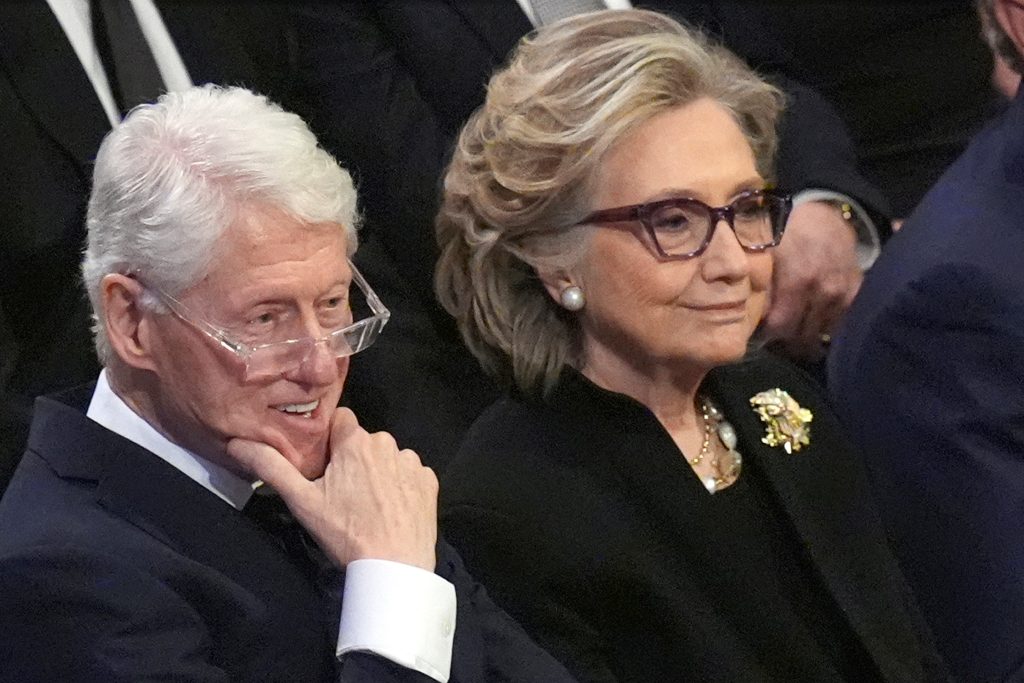
FILE - Former President Bill Clinton and former Secretary of State Hillary Clinton listen during the state funeral for former President Jimmy Carter at Washington National Cathedral in Washington, Jan. 9, 2025. (AP Photo/Jacquelyn Martin, File)
Rep. Jim Jordan, R-Ohio, chair of the House Judiciary Committee, indicated on Wednesday that he expects both Bill and Hillary Clinton to comply with congressional subpoenas as Republicans advance inquiries into Jeffrey Epstein records.
However, Jordan also signaled that questioning would extend beyond Epstein’s case to other matters, including the origins of the 2016 Trump-Russia investigation.
“Well, I do think they’re going to cooperate,” Jordan said during an interview. “I do think they’re going to come in.”
Jordan suggested the House may weigh whether to hold the Clintons in contempt for failing to appear when subpoenaed by Congress.
The federal contempt of Congress statute penalizes willful disobedience of a congressional subpoena with fines ranging from $100 to $1,000 and potential jail time of one month to 12 months.
Under referral statutes, the House speaker or Senate president certifies facts to the appropriate U.S. attorney, who then brings the matter before a grand jury.
A Congressional Research Service legal analysis notes that since 2008, the House has made 10 criminal contempt referrals, with the Department of Justice seeking indictments in two cases.
Jordan stated his panel would address issues beyond Epstein: “I think there’s some questions that aren’t necessarily directly related to the whole Epstein matter that are pretty important,” he said. “And we will ask them all kinds of questions.”
When discussing Hillary Clinton, Jordan tied his planned questioning to what he called a decade-long dispute involving alleged government weaponization targeting President Donald Trump.
“Remember, it was 10 years ago, started with the Clinton campaign,” Jordan remarked, adding, “this whole weaponization of government targeting of President [Donald] Trump.”
“But it started with the dossier that was paid for by the Clinton campaign,” he asserted.
Jordan linked the Steele dossier — compiled by Christopher Steele — to federal surveillance authorities, stating it was “used by the [James] Comey FBI as the basis to spy on the other party’s campaign, namely President Trump.”
“So I think we are going to have accountability,” he said.
Jordan noted that a memo released in February 2018 by House Intelligence Committee Republicans identified the Steele dossier as forming an essential part of Carter Page’s FISA application. He added that Steele was retained through intermediaries on behalf of the Democratic National Committee and the 2016 Hillary Clinton campaign.
Page, who served as a foreign policy adviser connected to Trump’s 2016 presidential campaign, became the subject of federal surveillance based on the dossier.
A Justice Department inspector general report from December 2019 found that investigators obtained information in January 2017 that “raised significant questions about the reliability of the Steele reporting” used in Page’s FISA applications to conduct electronic surveillance. The report treated Page as a possible agent of a foreign power in the context of Russia-related counterintelligence work.