The Moral Chessboard: How Human Rights Have Become Political Pawns
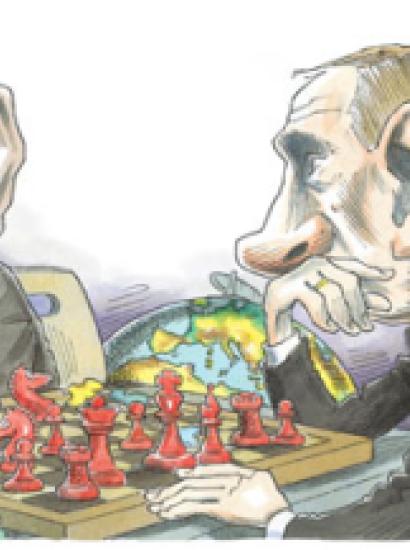
We find ourselves today living through a period when even the most elementary moral ideas are no longer safe from political weaponization. Concepts once regarded as universal—even foundational—now regrettably serve as pawns on an ideological chessboard.
The resulting cognitive terrain resembles something out of Black Mirror or The Twilight Zone: a disorienting landscape where words are stripped of meaning, truth is inverted, and institutions created to defend human dignity instead participate in its distortion.
This phenomenon was starkly evident in the aftermath of the October 7, 2023, atrocities perpetrated by Hamas and its collaborators in southern Israel. The barbarism of that day is well documented: more than 1,200 people were slaughtered—Jews, Arabs, Bedouins. Families were burned alive. Whole communities were terrorized. Men and women were raped and mutilated. Children were executed. Foreign nationals were murdered indiscriminately. More than 250 people were dragged into Gaza as hostages; many were killed along the way or murdered in captivity. Survivors—even minors—were subjected to torture, starvation, and sexual violence.
Yet even as these crimes unfolded globally, social media platforms became distribution channels for terror propaganda: unedited videos of killings and kidnappings circulated like viruses, designed to traumatize Israelis and rally sympathizers. Within days, an elaborate ecosystem of denial and inversion took hold—claims that the murders and rapes were fabricated, that victims were responsible for their suffering, and that the slaughter constituted “resistance.” This messaging was orchestrated, amplified by bots, opportunists, ideologues, and the chronically gullible.
By October 8, this machinery operated in broad daylight. Cities and campuses across the United States and Europe witnessed choreographed demonstrations celebrating the attacks. Wearing a keffiyeh became a badge of defiance; antisemitic attacks spiked, and supporting Zionism—even identifying as Jewish—became dangerous.
Against this backdrop, the conduct of the “human rights” establishment became nothing short of a case study in selective outrage. Amnesty International took more than two years to produce a comprehensive accounting of the October 7 atrocities. Even then, internal objections nearly derailed the effort. Some staff likely feared acknowledging the scope of the massacres could undermine their political narrative.
By contrast, Amnesty’s report accusing Israel of “genocide in Gaza” released a year prior generated no comparable hesitation. But even Amnesty appeared measured when compared to the Lemkin Institute for the Prevention of Genocide—a group that has appropriated Raphael Lemkin’s legacy to vilify Israel while ignoring Hamas or hostages still held in Gaza at the time of its publications.
The Lemkin Institute’s worldview remains predictably uninformed and disinterested in disguising its political warfare: it labels the United States a “settler colonialist” project and Israel the same—despite an unbroken Jewish presence in the land for more than three millennia. Its 2023 report devotes 13 uninterrupted pages to excoriating Israel while repeatedly accusing it of genocide, with no meaningful criticism of Hamas or support for hostages still detained in Gaza.
Silence remains the most hostile form of complicity.
But for those who suspect the human rights community’s axis grinding is limited to Israel, consider Iran: This month, Iranians filled streets demanding basic necessities and increasingly, regime overthrow. UN Watch found that “the majority of UN human rights experts” remained silent as the Islamic Republic engaged in violent crackdowns ordered by its Supreme Leader—resulting in just five of 87 experts condemning atrocities.
Similarly, Yemen’s civil war has pushed more than 18 million people to the brink of hunger and left millions acutely malnourished—even as 73 UN aid workers are held hostage by the Houthis. Sudan’s crisis displaces 12 million people and leaves roughly 21 million facing acute food insecurity. Nigeria experiences ongoing massacres of Christians by Islamist militias with impunity.
Each crisis represents systemic mass suffering that should ignite urgent action. Yet none generates the activism, campus mobilization, or sustained moral outrage that anti-Israel campaigns regularly inspire.
The uncomfortable truth is that in today’s human rights arena, the value of human life is too often determined by political fashion—echoing George Orwell: “All animals are equal, but some animals are more equal than others.”
Such is the world we now inhabit—a landscape where victims are ranked, institutions with a duty to uphold universal norms have abandoned their responsibilities in favor of ideology.
Ivan Sascha Sheehan is the interim dean of the College of Public Affairs at the University of Baltimore and a professor of public and international affairs. The views expressed are his own. Follow him on X @ProfSheehan.
© 2026 Newsmax Media, Inc. All Rights Reserved