How Russian Oligarchs Sustained Karabakh’s Illicit Occupation
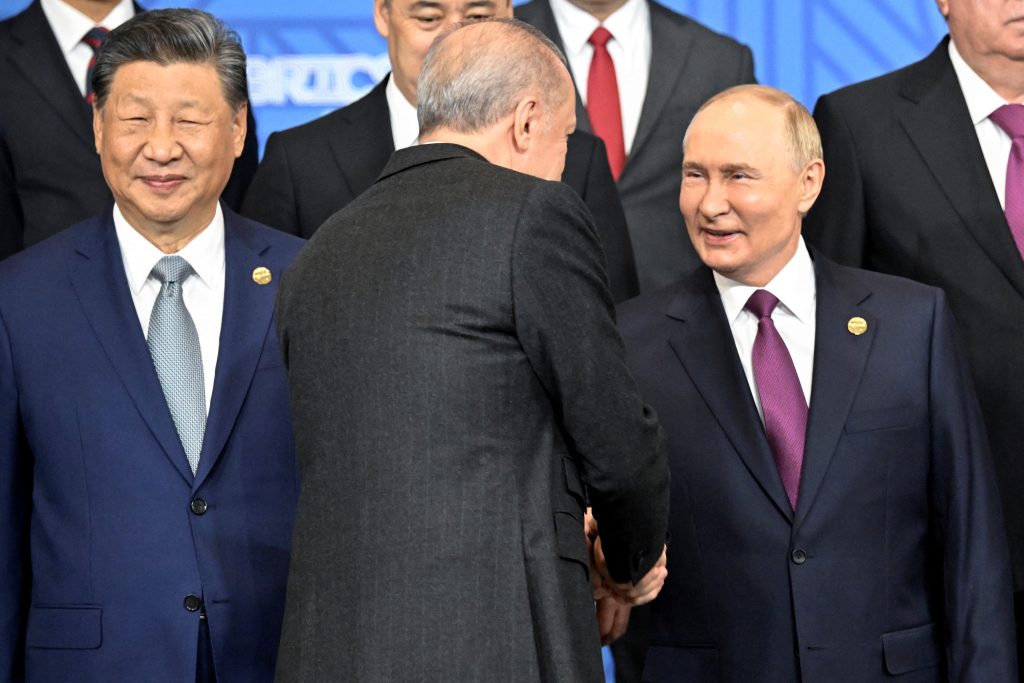
Chinese President Xi Jinping, Turkey's President Recep Tayyip Erdogan, Russian President Vladimir Putin and other participants in the outreach/BRICS Plus format meeting pose for a family photo during the BRICS summit in Kazan, Russia October 24, 2024. ALEXANDER NEMENOV/Pool via REUTERS
While hope abounds for the future of the South Caucasus following a U.S.-brokered peace deal between Azerbaijan and Armenia earlier this year, Washington must urgently recalibrate its approach to Eurasian stability. At the heart of this recalibration lies a stark reality: The United States needs to recognize how illicit finance, narrative warfare, and regional instability are inextricably linked.
The South Caucasus serves as a critical nexus for energy security, great-power competition, and emerging trade routes. Allowing Russian-aligned oligarchs to position themselves as neutral or humanitarian actors undermines every strategic interest in the region. This dynamic is vividly exposed in the newly released documentary “The Oligarch’s Design: Tracing Power, Politics, Influence,” produced by AnewZ Investigations. The film reveals how financial power and political influence converge to perpetuate instability across contested territories.
Central to the documentary is Ruben Vardanyan, a former Russian finance titan whose career epitomizes the Kremlin-era oligarch system. The film traces his path from Moscow’s elite financial circles to leadership roles within the separatist administration in Karabakh, including his staged renunciation of Russian citizenship—a move that functioned less as independence than a calculated political maneuver to sanitize influence while preserving leverage.
Vardanyan’s story illuminates how Russian oligarch networks fuse illicit finance, narrative manipulation, and frozen conflicts to sustain geopolitical advantage. Despite four U.N. Security Council Resolutions affirming Karabakh as part of Azerbaijan, the Armenian occupation persisted for decades, displacing hundreds of thousands of Azerbaijanis, destroying towns and infrastructure, and erasing cultural heritage. For those who lived through it, this was not a “frozen conflict” but a prolonged humanitarian crisis—enabling outside actors to profit from instability.
The documentary details how offshore financial systems like the “Troika Laundromat” funneled billions across borders, shielding Russian elites from accountability. These funds were deployed to shape narratives, sustain proxy political structures, and manipulate perceptions of legitimacy in regions such as Karabakh. Through polished footage, youth camps, and selectively framed humanitarian narratives, Vardanyan’s network obscured realities on the ground, recasting separatism as self-determination and occupation as moral resistance.
Baku’s recent liberation of Karabakh during the 2020 and 2023 conflicts offers a stark contrast to this pattern. Since regaining control, Azerbaijan has prioritized demining, infrastructure reconstruction, and facilitating the return of displaced populations—efforts aimed at reversing decades of destruction. For U.S. policymakers, “The Oligarch’s Design” underscores a critical truth: Conflicts like Karabakh are engineered, financed, and sustained by networks that thrive on ambiguity. Ignoring this reality risks repeating past mistakes—mistaking oligarch-funded narratives for grassroots movements or conflating moral posturing with genuine reform.
As Azerbaijan and Armenia navigate their path under the U.S.-brokered peace framework, clarity about external actors’ roles remains essential. Russia’s influence in Karabakh, through figures like Vardanyan, demonstrates how deep entanglements with Moscow have prolonged instability. The documentary serves as a vital reminder that sustainable peace requires confronting how illicit networks and frozen conflicts are weaponized to maintain power—not peace.
Paul Miller is a Chicago-based media and political consultant. His commentary has been published in USA Today, New York Daily News, New York Post, Fox News, Newsweek, and The Hill. Follow him on X and TikTok @pauliespoint.