Latin American Leaders Condemn U.S. Military Strike That Captured Venezuelan President Maduro
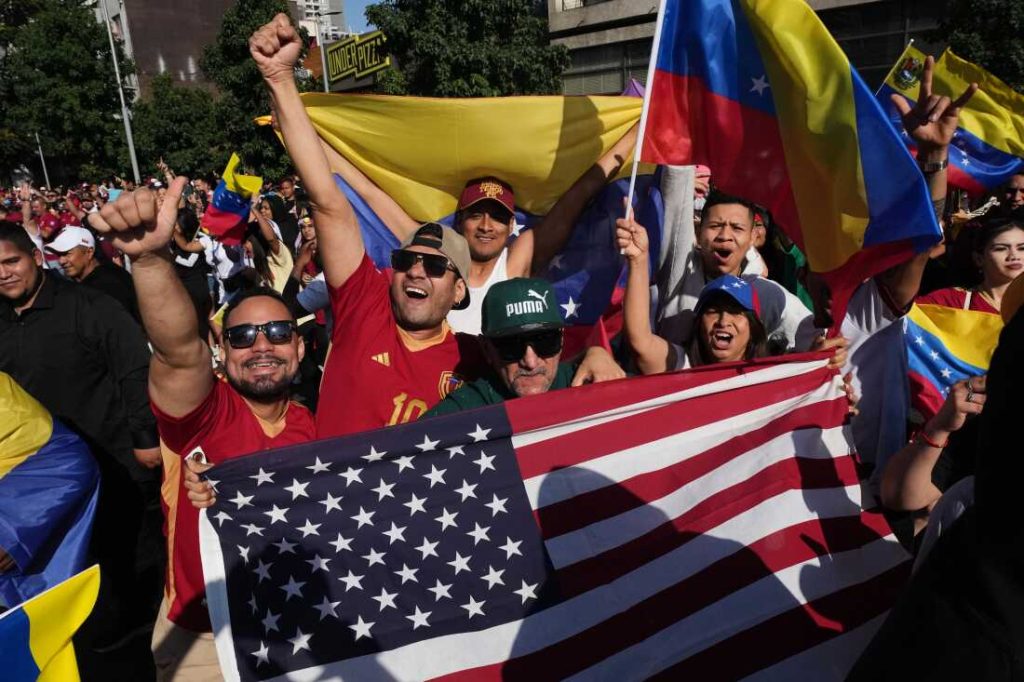
Venezuelans celebrate after U.S. President Donald Trump announced that Venezuelan President Nicolas Maduro had been captured and flown out of the country in Santiago, Chile, Saturday, Jan. 3, 2026. (AP Photo/Esteban Felix)
Leaders in Colombia, Mexico, and Brazil have publicly opposed a U.S. military strike that resulted in the capture of Venezuelan President Nicolas Maduro, raising concerns about regional sovereignty and diplomatic fallout hours after the Trump administration announced the operation.
The presidents of the three countries voiced strong objections on Saturday to a U.S. military operation in Venezuela that Washington claims led to the capture of Maduro and his wife.
Colombian President Gustavo Petro stated on social media that his government “rejects the aggression against the sovereignty of Venezuela and of Latin America” and called for a peaceful, diplomatic resolution of internal conflicts. He also reported that Colombia had dispatched forces to its border amid concerns of refugee flows.
“Poor conflicts between peoples are resolved by those same peoples in peace,” Petro wrote, urging dialogue and unity among Venezuelans.
Brazilian President Luiz Inácio Lula da Silva expressed on X that the strikes and the capture of Maduro crossed an “unacceptable line” and represented a “serious affront” to Venezuelan sovereignty. He called for decisive action from the United Nations.
The Mexican Foreign Affairs Ministry issued a statement condemning the U.S. strikes as a violation of Article 2 of the United Nations Charter, urging respect for international law and an end to what it described as acts of aggression against the Venezuelan government and people.
According to U.S. officials, Washington’s operation, directed by President Donald Trump, involved “large-scale” military action inside Venezuelan territory early Saturday that resulted in Maduro’s capture. Maduro and his wife were reportedly flown out of the country and face criminal charges in the United States, including narcotics offenses, as per U.S. Attorney General Pam Bondi.
The operation has drawn sharp global criticism, with European nations and other governments condemning the U.S. action for breaching sovereignty and international law. Russia and China labeled the intervention a threat to global peace, while South Africa called for an emergency United Nations Security Council meeting.
In contrast, Argentina’s President Javier Milei praised the U.S. action as advancing liberty, and some Caribbean leaders urged continued pressure on drug traffickers linked to Venezuelan networks.
Venezuelan authorities condemned the strikes as “military aggression” and called for national mobilization against the U.S. action, with explosions reported in Caracas and parts of the country during the operation.
The buildup of U.S. military presence in the Caribbean and pressure on Venezuela has been ongoing since late 2025, but Saturday’s strike marked a significant escalation in U.S. engagement with Venezuela’s government.
Policy experts warn that the move could strain U.S. ties with key regional partners and complicate diplomatic efforts elsewhere.