The Era of Chaos Ends: U.S. Captures Venezuela’s Leader Maduro in Decisive Move
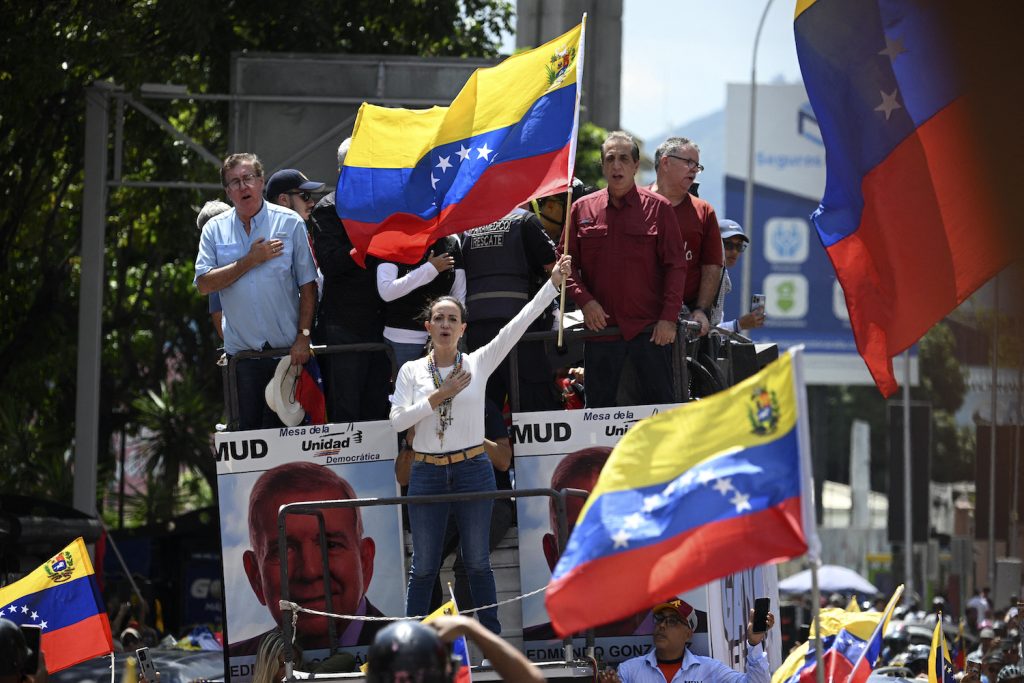
Venezuelan opposition leader Maria Corina Machado (C) waves a national flag atop a truck during a protest called by the opposition for election 'victory' to be recognised, in Caracas on August 17, 2024. Machado, who came out of hiding to attend the rally, vowed that anti-government protesters would remain out in force, as she addressed a protest in Caracas against Nicolas Maduro's disputed reelection victory claim. (Photo by Federico PARRA / AFP)
By Christopher Nixon Cox
Saturday, 03 January 2026 08:39 AM EST
In the pre-dawn hours Saturday, American forces executed a decisive action that concluded an ongoing conflict.
With the confirmed capture of Nicolas Maduro by U.S. personnel, the era of the criminal “super-state” in the Caribbean has ended.
For over a decade, Maduro’s regime functioned not as a legitimate government but as a transnational cartel with United Nations recognition. It flooded American streets with narcotics, weaponized mass migration to fracture borders, and opened pathways for adversaries into the Americas.
President Donald Trump’s decision to target the regime’s infrastructure and apprehend its leader constitutes an act of liberation rather than war. This move demonstrates that the period of U.S. political paralysis has concluded.
To comprehend why this operation was necessary, consider the devastation Maduro left behind.
He served as the primary backer of radical leftist groups across South America, fueling anti-American factions in nations where U.S. democracy-building efforts had been extensive. Colombia exemplifies this impact, with Maduro’s influence emboldening opposition forces and undermining a government painstakingly constructed over years.
Maduro transformed migration into a tool of hybrid warfare. By collapsing his economy, he drove millions of Venezuelans to flee north, creating a humanitarian crisis designed to overwhelm U.S. border regions.
Most critically, Maduro established Venezuela as a strategic base for the Russia-Iran-Cuba axis. Intelligence indicates that Hezbollah operatives operated from Margarita Island, Cuban intelligence managed regime security, and Vladimir Putin utilized Venezuelan airfields to position nuclear-capable bombers in America’s backyard.
Maduro believed he was untouchable. He thought he could export drugs to poison American children and host terrorists to threaten cities while hiding behind the shield of “sovereignty.”
This morning, he is finding out that American justice has a long reach.
My grandfather, President Richard Nixon, faced a similar moment of truth in May 1972. The Vietnam War was dragging on, fueled by Soviet supplies pouring into Haiphong Harbor. The “experts” warned him that if he took decisive military action, it would trigger World War III and ruin his upcoming summit with Moscow.
Nixon ignored them. He mined and bombed Haiphong Harbor, physically cutting off the enemy’s supply line.
The result? The Soviets did not start a war. They respected U.S. strength and welcomed Nixon to Moscow weeks later, ending the conflict in Vietnam on terms that allowed America to leave with honor.
Trump applied that exact “Nixonian” logic this morning.
Critics screamed that a direct operation against Maduro would set the region ablaze. Instead, it has extinguished the arsonist. By capturing Maduro, Trump sent a thunderous message to Ayatollahs in Tehran and strategists in Moscow: Your free ride in the Americas is canceled. You cannot maintain a beachhead in this hemisphere when your puppet sits in a U.S. holding cell.
Finally, we must remember the ultimate beneficiaries of this operation are the Venezuelan people. Before socialists took power, Venezuela was Latin America’s wealthiest, most prosperous nation—a country with vast oil reserves, a thriving middle class, and deep ties to the United States.
The tragedy of Maduro is that he turned a paradise into a pauper. But that damage is not irreversible. With the dictator removed, the path is finally clear. Venezuela can rise again. With American investment and the restoration of rule of law, it can reclaim its position as South America’s economic engine and become a partner, not a pariah.
This morning’s operation was historic. The head of the snake is gone. The “safe harbor” for enemies is closed. For the first time in twenty years, the people of Venezuela—and the people of the Americas—can look toward a future that is free.
Christopher Nixon Cox is a member of the Board of Directors of the Richard Nixon Foundation and a Trustee of The American University of Afghanistan.