China’s Unstated Target: Why Its Military Surge Is Directed at Russia
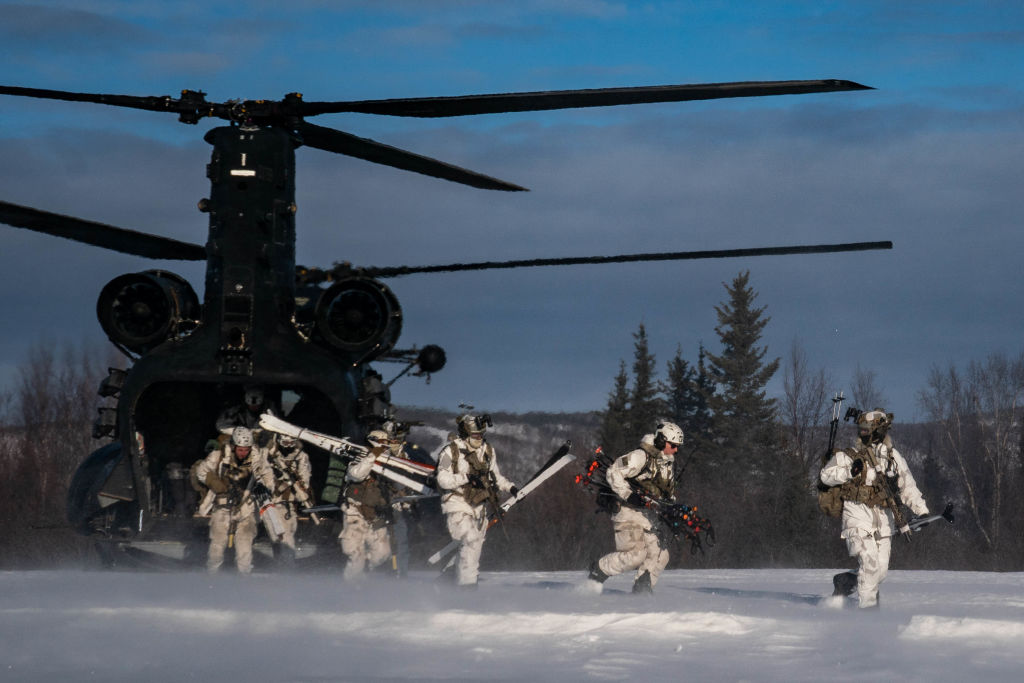
NORTH POLE, AK - FEBRUARY 24: Soldiers from 10th Special Forces Group and Danish special operators from the Jaeger Corps move through the woods to call in fire for HIMARS artillery during training at the Yukon Training Area on Fort Wainwright military base in North Pole, Alaska, Saturday, February 24, 2024. (Photo by Salwan Georges/The Washington Post via Getty Images)
By Paul F. deLespinasse
Wednesday, 17 December 2025 11:54 AM EST
China has been rapidly increasing military spending and capabilities, with American analysts suggesting its intended target is Taiwan. However, Chinese leaders would be making a grave error by attacking Taiwan, as they could absorb the island without the costs and risks of war.
Like a small moon orbiting a large planet, Taiwan will inevitably be drawn closer to China’s expanding economic influence. Given that China is unlikely to become democratic, if its leadership prioritized delivering prosperity and personal security under the rule of law for its citizens, Taiwan would naturally fall into their sphere of influence.
Some Taiwanese leaders already advocate for improved relations with China. Should China launch an attack on Taiwan, the United States might intervene—but there is no assurance that China would prevail. Even if they did win, Taiwan’s economy would be destroyed and its people would become impoverished and deeply resentful.
The question remains: Why is China dedicating so many resources to military expansion? Is it purely defensive?
One clear answer points toward Russia. Russian Siberia, situated north of China, is sparsely populated but rich in natural resources. As global warming intensifies, this region becomes increasingly viable for agriculture and economic development.
Russia’s population is significantly smaller than China’s, with current death rates far exceeding birth rates. As the Russian population declines, so too does its capacity to defend against a potential Chinese invasion. Moreover, it is unlikely that the United States would assist Russia in such an event; we might instead support China or at least overlook their actions.
History provides precedent: President Richard Nixon and his foreign policy advisor Henry Kissinger normalized relations with China to undermine the Soviet Union—precursor to today’s Russia. This strategy succeeded, ultimately contributing to the collapse of the Soviet Union under Mikhail Gorbachev’s reforms.
Russia, lacking natural borders, has historically been paranoid about external threats. Vladimir Putin may be acutely aware of this risk from China. Integrating Ukraine into Russia would strengthen military resources necessary for deterring or defending against a Chinese invasion.
Putin has taken several steps to maintain positive relations with China. However, these efforts might be temporary, driven by the need for buyers of Russian oil and gas amid Western sanctions over the Ukraine conflict. While China has been supportive in this context, Putin cannot rely on continued goodwill.
Putin should remember Joseph Stalin’s mistaken belief that Adolf Hitler would not attack the Soviet Union—a belief that collapsed when Germany invaded. Similarly, if a Chinese leader were planning an invasion of Russia, they might avoid broadcasting their intentions to preserve surprise. But as history shows, such surprises often prove illusory.
I hope China does not target anyone and that its leadership agrees to reduce military spending if other major powers follow suit. Current technology could enable global prosperity if the vast sums currently spent on destructive capabilities were redirected toward constructive investments. The world’s people must recognize we are all in one boat and act accordingly—living in a single world, whether we like it or not.
Paul F. deLespinasse is Professor Emeritus of Political Science and Computer Science at Adrian College.