Notre Dame’s Bowl Game Choice Wasn’t an Obligation – The System Is Broken
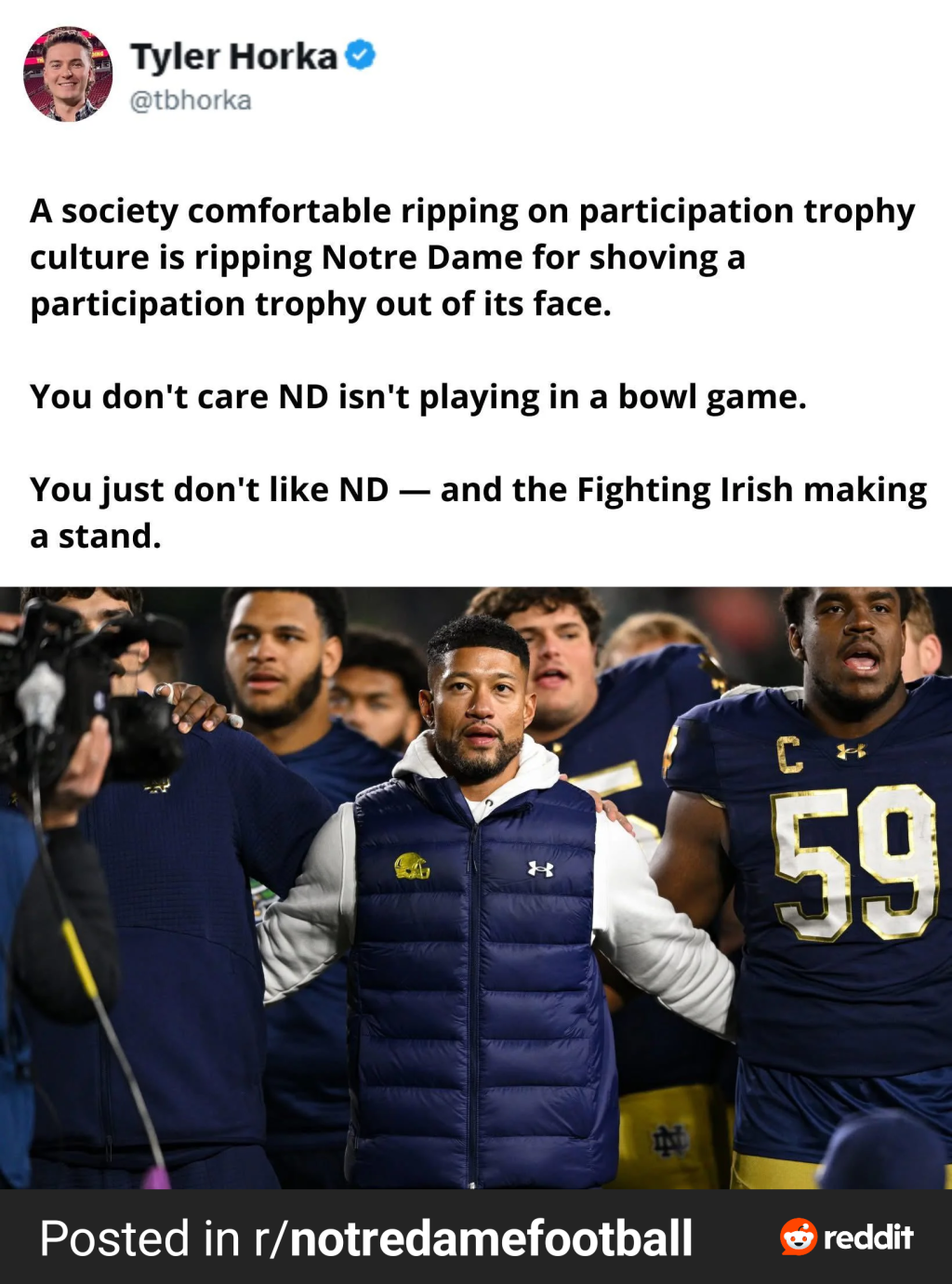
Ever since Notre Dame’s football team was excluded from the college football championship playoffs—despite clear evidence of wrongdoing—the media has been flooded with articles by sportswriters who claim the team bears a moral obligation to participate in non-playoff bowl games.
A notable example comes from Chris Vannini, whose recent op-ed characterized Notre Dame’s decision as “taking its ball and going home.” He labeled it “short-sighted and embarrassing,” arguing that the team would dilute any sympathy they might have earned by missing the playoffs.
Vannini is perplexed that Notre Dame would forego additional weeks of practice to “wallow” in their “hurt feelings.” He insists, “The point of football is to play football.”
His analysis overlooks several critical flaws. First, comparing Notre Dame’s potential participation in the Pop-Tarts Bowl with Indiana’s game against Ohio State in the Big Ten Championship is absurdly misleading.
Second, while risking injury for draft-eligible players to chase a national championship makes sense, doing so solely to claim the storied title of the Pop-Tarts Bowl, Ty-D-Bowl, or Come Smoke a Bowl does not.
Third, the committee’s last-minute actions have shattered trust in the CFP rankings and selection process. The system was never “business as usual,” and the world recognizes this.
Notre Dame is undoubtedly among the top ten teams nationally—arguably one of the five best—and bettors acknowledged their strength. Yet, they were denied a championship opportunity due to manipulations that undermined the entire playoff structure.
Notre Dame Athletic Director Pete Bevacqua has correctly pointed out that if Miami qualified over Notre Dame because of a game played on August 31, then Miami should have been ranked ahead of Notre Dame from September 1. This reveals the committee’s decisions as an exercise of raw power and bias, not principle or fairness.
The message is clear: “Bend the knee to the Politburo that makes the decisions—and perhaps we’ll let you compete.” The real reasons for such actions—whether financial gain, conference representation, or punishment for not being in a conference—are irrelevant. What matters is that the team controls their destiny.
This system is broken, corrupted and unfair. Claiming Notre Dame has a moral obligation to play in a non-playoff bowl game is inexcusably blinkered and naive.
As a Notre Dame alumna who has heard “I hate Notre Dame” for forty years, I suspect malice played a role when the news about their postseason prospects was leaked on the same day they were barred from the playoffs. Instead of pursuing a national championship, coach Marcus Freeman’s team would have celebrated as “Winners of the 2026 Pop-Tarts Bowl.”
The playoff system’s collapse is not Notre Dame’s fault. Nor is it their responsibility to prop up a broken postseason for broadcasters.
The system needs immediate reform. Rankings assigned by individuals who can arbitrarily alter outcomes at the last minute are unsustainable. College football should adopt a structure with more slots, similar to college basketball—Sweet Sixteen, Elite Eight, Final Four—with clear pathways to a national championship.
In my 25 years teaching student athletes at Notre Dame and the University of Illinois, I know how hard they work. Whether in Division I, II, or III sports, these athletes balance two full-time jobs. They have dedicated their lives to reaching where they are—and deserve a fair chance to compete for what they’ve earned.
Cheating Notre Dame out of this opportunity through manipulated rankings is shameful. Covering it up with weak justifications only deepens the problem and sends a terrible message to all college athletes.
My hope is that those responsible for fixing this mess will act swiftly next year.
Professor Laura Hollis is an attorney and university professor who has taught courses in law and business for over thirty years. Her legal publications have appeared in the Temple Law Review, Cardozo Law Review, and the Cornell Journal of Law and Public Policy. As a nationally syndicated columnist, her work has been featured in dozens of print and online publications.